sábado, 15 de febrero de 2014

Has our class discussion affected your view of poetry? If so, how? What is your view of poetry after our discussion?

On this last week, we started to see a new topic on our class: poetry. As in our Spanish Literature class, on our English class we have to see this topic in order to be prepared on our IBO exams. 

We started discussing in class one essay made by the writer Octavio Paz called "Poesía y Poema". By the time we were reading this essay, we were talking about the different aspects that we can see in poetry. I think that this discussion was a good start for us to know more about what is poetry and some of its principal components. This discussion in class change somehow my view about poetry, because before discussing in class what does poetry mean to some writers and seeing the main elements of it, I tend to relate it to something boring that do not make sense at all. I really thought that poetry was made only for things related to love and philosophy, but I think that I was wrong. The discussion in class made me realize that poetry can talk about any theme and everybody, with the main elements, can make poems.

Now I have a new view about poetry to start studying it on class, because I think now that poetry may be interesting to study on this semester. More than studying the rhymes, types of poetry and other elements(that we will see in the respective time and we would have to analyze it), I think that it will be interesting to discover the emotions, feelings and thoughts that the poets wanted to transmit in their works for the readers to understanding it. The discussion was good for us to know each other's opinions about poetry and with time, we can see how us change our view about this kind of works.

domingo, 9 de febrero de 2014

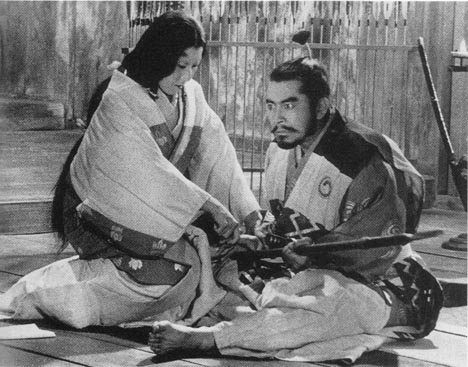
What new perspective can Semiotics bring to your perception and analysis of symbols (aural, visual, or otherwise)? Now that we have finished watching Throne of Blood, what new insights have you gained into Macbeth or in your life in general? What did I learn from watching it? Why? How?

Over the past weeks, we have been seeing what semiotics is for having one perspective about analyzing literature, as well as watching and comparing the similarities and differences between the movie "Throne of Blood" and Shakespeare's play Macbeth. 
First of all, in past classes we have been learning about what semiotics is and the benefits that we can have by comprehending this theory and the knowledge that this theory can bring us for our literary analysis for future essays. We learned that semiotics is the theory and study of signs and it is used for our communication. It can be from words, to signs we see on streets and commercials. Semiotics is everything (or every signified) that has a meaning (or a signifier).By analyzing symbols or a set of symbols on literature, we can have a more deep comprehension about a novel,a play or an essay we are reading. By knowing more about semiotics, I am understanding better why people from our culture and other cultures use certain word or group of words to communicate certain things or feelings(like the onomatopoeia's), also visually I can understand why people that are studying marketing, for example, need to use certain symbols in their products to attract more customers. Also the symbols we see on the streets we can have a new perception of seeing them and realizing that even a person that  knows other language or is a tourist that does not know anything about that language, by the signs and symbols can understand the same as the native people living on that place.
 On the other hand, the last week our teacher brought us a movie to see it on class called "Throne of Blood", that is the Japanese adaptation of Shakespeare's Macbeth. While we were watching it part by part, we were making either by a writing or by commenting it, comparisons and contrasts between these two works. In my opinion, it is not the same reading something and imagining it than watching something. I think that seeing this movie gave our class the idea of what Macbeth consisted: ambition and natural human aspirations for gaining more power against a lot of values and people we care about. Personally, I learned from either the play or the movie that, we have to follow our beliefs and values no matter what the situations are. I know there are a lot of people out there that want you to tear you apart or destroy you through assumptions, lies and suggestions about what can you achieve or what can you be if you use methods that do not match your values and ideals.
As human beings, we tend to be weak about these kind of things because sometimes we are insecure about us, but I think that we have to be strong enough to say no and stay true with ourselves, because like the witches and Lady Macbeth in Macbeth or the witch and Asaji in "Throne of Blood", people will start telling you to change to see how far you can get to change yourself, and if it is late, the consequences of that changes can be catastrophic. Reading the play and seeing the movie taught me to keep staying like I am and if I had dreams and aspirations for being something "bigger" that I am now, I have to keep working hard and believing on destiny and God to help accomplish my dreams. 


martes, 4 de febrero de 2014

What are the similarities you have found in Kurosawa's Throne of Blood with Macbeth? How does Asaji-dono differ from Lady Macbeth? How does her approach to convince Washizu differ from Lady Macbeth's to convince her husband? What other differences can you find, other than the obvious ones(setting, character names, etc.)? Why would Kurosawa choose to emphasize certain aspects over others Shakespeare emphasizes?

On Friday, we say part of a Japanese movie, directed by Akira Kurosawa called "Throne of Blood". This movie was based on Shakespeare's play Macbeth. There are many similarities in this movie that we, as audience, can relate to Shakespeare's short tragedy. 

First of all, except for the names, the characters  in "Throne of Blood" are the same as in Macbeth. The two generals, Washizu and Miki, represent in their Japanese culture Macbeth and Banquo, the two honorable generals. As well as in Shakespeare's play, Asaji is in "Throne of Blood" Washizu's wife, alike to Lady Macbeth. The place where the story takes place in the movie is feudal Japan, very similar to the Middle Ages where Macbeth takes place. So far, the story is likely the same as in the play. The movie starts with important people and the emperor of Spider Web's Castle, that told him about two generals that are very brave and did a lot for him: Washizu and Miki(this is similar to the beginning of Shakespeare's play). Another important similarity is the witch that Washizu and Miki meet in a forest. Different to Macbeth, there is only one witch in "Throne of Blood", but she tells the same prophecy to these characters as well as the three witches in the play told Macbeth and Banquo good future to them and their descendants, respectively. And as well as in Shakespeare's play, from the moment that they are promoted, Washizu(like Macbeth) will start aspiring to be, as the witch told him, emperor or Lord of Spider Web's Forest, even if for that he has to kill his Lord Tsuzuki.  Another important similarity is that ambition, power and magical characters are appaearing in this movie, as well as in Shakespeare's play.

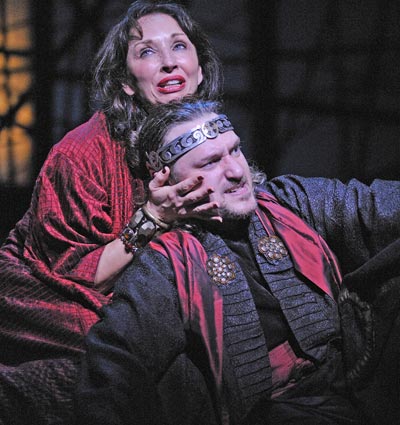
There is one certain aspect of this movie that we have to analize: how Asaji-dono has convincing her husband, Washuki, for trying to kill his Lord further on the movie. Lady Macbeth and Asaji are simmilar in their characters, but they differ in certain aspects. First, their characterization. Shakespeare puts Lady Macbeth as an European ambicious woman, with sumptous jewerly. In "Throne of Blood", they characterize Asaji as the typical Japanese woman of feudal Japan, wife of a man of power in the reign(the general).Another aspect that we can see the differences between these two women is the way they convinced their husbands in their respective plots. The two of them convinced by their desire of power and to be more than a general. In Macbeth, Lady Macbeth convinced Macbeth by telling him that is a coward, that he was not a real man because of his cowardice. She also convinced him because she, compared to Macbeth, had more power to manipulate with the force of her words Macbeth's mind. In "Throne of Blood", Asaji convinced Washaki with calm and feminity. She was not dramatizing about the situation. She told her husband future bad consecuences of staying with the position that the Lord gave him. She told him that maybe his best friend, Banquo, told the Lord about the prophecy and know wanting him dead. Different to Lady Macbeth, Asaji confused Washaki about his future if he do not kill the Lord in order for them to be more powerful and being Lords of Spider Web's Forest.

Even that it is practically the same story, there are some differences, basically because of the different cultures. In Macbeth, the characters that represent the generals and the nobility seem to be refined and nice. In "Throne of Blood", the characters are more stiff. Another difference is the symbols they have in their respective kingdoms and the way they are dressed. I do not understand Japanese, but by the English translations, some dialogues differ from the one of Shakespeare. This differences can be due because I think the director of this movie, Kurosawa, wanted to "capture" the essence of Macbeth(which is the natural seek for power, the gaining or lost of honor and the consecuences that this can bring) in a Japanese context. Shakespeare in Macbeth emphasizes more about how a simple man can be convinced by ambition due to confusions about himself and his believes and letting him go by this ambition for more power. 

Here is the link for you to see a little trailer about Kurosawa's movie. So, what simmilarities and differences you can see? 

lunes, 27 de enero de 2014

What does Shakespeare have to say about human nature? Use specific examples. What do you have to say about that? Why?

By now, most of our classmates have finished reading Macbeth's play, written by Shakespeare during the 17th century in England. Besides that it is a great play having a lot of different contrasts about their characters and has a very interesting plot ,we need to consider what does Shakespeare wanted to transmit not only on Macbeth, but in other works he had done in general about human nature. As we know, William Shakespeare is now known from creating characters that have universal human qualities, from loyal people to selfish people. The problems that Shakespeare's characters have are universal, which means that most of the people use to struggle with. Sometimes, they are successful and sometimes their lives are full of pain, suffering, and failure(Field-of-themes).
One example is the short tragedy we read in class, Macbeth. This  play has elements like ambition and evilness, things that human beings have naturally and can lead them to kill someone or changing his way of being. The main character of this play,
Macbeth, was a normal man that was motivated by ambition and by the fear of appearing weak and small in the eyes of his wife(Dalrymple), he started to commit crimes without a justification or excuse. At the beginning of the play he was considered a hero, a brave soldier that fought for good causes, but most of all he was loyal to his king Duncan, which in the play was a good king. This Shakespeare's character had nothing to complain about, there was not any excuse for committing the murders, and he even realizes it, because he was rich and was the Thane of Glamis.The only reason that Macbeth killed Duncan, Banquo,and MacDuff's family was because of ambition to be king of Scotland; he was led to evil by his ambition. Shakespeare understood this natural thing that human beings have, because we like in a society in which the search for power and better positions is unavoidable, and some people tend to reach for that power through corruption and by "embracing" the evil. In contrast to Macbeth, the two murderer that he hired to kill Banquo and Macduff's family, where evil since the beginning of their apparition, they did not have to change his way of being like Macbeth in order to reach what they wanted(money or rewards).
By this example, Shakespeare writes (and he also showed in his plays) that "the line separating good from evil passes not through states, nor between classes, nor between political parties either-but right through every human heart- and through all human hearts".
Also in the play, Shakespeare puts elements that human beings have when we commit crimes or things due to the evilness we have inside: we felt guilty and regretting the things we have done. In other words, we felt the consequences of our actions. One example is Lady Macbeth, that she took the decision to be evil. But in the Sleepwalking scene, she confesses everything that she and her husband, Macbeth, did. Finally, she died on the next scene. 
In my opinion, I think that Shakespeare in Macbeth and in other plays transmitted through his characters things that were similar in the 17th Century and in our time: the human nature. The way we act, the decisions we make(good or bad), and the consequences of those decisions. We, as human beings, have to live with all the good and bad things that we do everyday. Also, I think there is evilness in each and everyone of us, but we need to control it and have a balance between our good and evil sides. We do not want to be like Macbeth, that because of ambition and power, he felt guilty since the time that he killed Duncan to his death. 

References:

  • Dalrymple, Theodore. <Why Shakespeare is for all Time>. Catholic Education Resource Center. Web. 26 Jan 2014. http://catholic education.org/articles/arts/al0189.html 
  • <William Shakespeare>. Field-of-themes.com Web. 26 Jan 2014. http://www.field-of-themes.com/shakespeare/essays/Eshakehis.html

domingo, 19 de enero de 2014

What are the themes revealed in Macbeth so far? What are some of the aspects of the play you have liked at this point? What haven't you liked? Why?

 The English writer William Shakespeare was one of the most important writers of English literature. It is said that he is the "father" of the modern English, because he created more than two thousand words for the English language during the English Renaissance. Besides his work as an actor and writer, nowadays he is world renowned as a playwright. One of his famous plays is a short tragedy called Macbeth, which was written approximately in 1606, during the reign of James I after the death of Elizabeth I. 
 Macbeth, tells the story about a general from Scotland named Macbeth, who is the Thane of Glamis and very brave and an honorable man. It is because of a profecy of three witches that he will be Thane of Cawdor and later,King of Scotland; but the power that he starts to desire transforms him into a murderer. One of the themes that I have identified during this week that we have been reading Macbeth, is the ambition of the principal character to be King of Scotland. At the beggining of the play, Shakespeare represent Macbeth as a good general which everyone admires and respects. It is represented with values like courage and simplicity, but when he met the witches something changed, he starts to think about the profecy and later, to plan something to kill the King Duncan. But for this act, there is another character that is very ambitious and wants more power, Lady Macbeth. There is another theme that I found during the first act: masculinity. If Lady Macbeth had not told him anything about his masculinity and that he was a coward for thinking and reflecting about killing the good king that was Duncan, he will never would have kill him. Proving that he was a man, at least to his wife, was the murder of King Duncan for them to become the King and Queen of Scotland. 

As far as we have reached in class, I am liking what is happening in the play. The way Shakespeare arrange the words for them to sound with a certain rhytm is fascinating. I know that there are many words that we do not understand sometimes, but once we search them we understand it better. Another aspect that I like is that Shakespeare puts in this play some historical aspects related to the king of that time, James I. Banquo was one of the predecesors of James,and the way that the witches told Banquo in the play that one of his descendats would be king is awesome, because Shakespeare related everything with their plays. One of the aspects(talking about the play)that I do not like so far is the character of Lady Macbeth. She is so manipulating and she wants more power than Macbeth, she is kind of sick of ambition and I hope during the rest of the play she pay the consequences for being like she is. About everything else, I think that even that it seems to be a short play, it has a lot of elements that in class we can discuss and new words that we can learn. 

lunes, 4 de noviembre de 2013

What did you like about the stories we read? What didn't you like? Why?

This third partial we are reading in our English class short stories from translated works of different authors. We have seen stories of Kafka, Salih, Chekhov and others. This stories take no more than fifteen minutes to read them, but they can help us to analyze a lot of things that are hidden and the author wants us to discover. 


What I like about the stories we are reading is that they are short compared to the novel we were reading and other stories; they are also fast to read them. I like that some of the authors of this short stories are known, like Kafka.Also I like that in our classroom each of us have an opinion about the stories we are reading and discover together the answers to the what, how and why of this stories.  What sometimes I do not like about this short stories is that because they are translated works, sometimes we cannot discover all what the author really wanted to say in his or her stories. This is due to the different meanings that words can have when we translate them to another language like Spanish or English. Because of the origin of the stories, I also do not like that I get confused in some terms and names that are not from the English language. 

I am liking that from short stories we are going to make a comparison and constrast essay, which sounds easy but we have to read carefully the stories for making a good job. 

domingo, 27 de octubre de 2013

Put your own life into the Hero's Journey. Identify archetypes and some of its stages.

In this past week, we saw in class a narrative pattern of an American scholar named Joseph Campbell. It was very interesting to see how this pattern repeats on a lot of stories and movies, even if they are different from each other. There are certain archetypes that Campbell uses in his theory or narrative pattern in order to identify easily the different characters that are going to obstacle or help in the story. This pattern is not only on stories, it can be in our own lives. For example, I will make an analysis of the "story" of my life identifying some Campbell's stages and archetypes. Maybe not all my life because it will be too long, but from an event that I consider was the start of a new stage of my life. 
 If we apply the Campbell's archetypes in my story, I would be the heroine. I am the central figure in what is my story. Well, the story that I will tell here stared two years ago. Since I remember I lived in Monterrey, Mexico. According to Campbell, this would be my ordinary world. One day, my dad told me and my mom that we were moving to Mexico City. My father, with the news that we were going into a new city after living all my life in Monterrey was like a herald and that event was like "a call to adventure". Obviously, I refuse to go (refusal of the call) because all my friends and special moments of my life were in Monterrey and leaving for knowing a new city scared me. After a couple of days I accept to go. Maybe in my story my mentors are my parents, because they guide me to keep going on no matter the situation; so I think meeting a new mentor or something is not in my story. 
Well, by August 2011 we moved to Mexico City. Leaving my home, the city that saw me growing, and my friends was a very difficult moment for me, but I was excited to go on this new "adventure"(this moment I identify it as Crossing First Threshold). When we arrived to Mexico, I was very scared to go into the last year of Junior High School. But I knew that this change was inevitable(Belly of the Whale)and I was not in Monterrey. I identified my fears and doubts about me as threshold guardians, because if I do not know how to "open" them, I would be alone in my new school and without friends. I think with time I start to break that fears, with the help of my new friends. Even that I was very happy in that new school, there were a couple of girls that were like double-faced and believe that I do not noticed that. This girls, I identified them as shapeshifters, because they were sometimes good with me and proving that they were loyal friends but on other situations they used to temptate me about getting into alcohol, cigarettes and other weird stuff. Obviously, I do not accept that things because my objective was to enter to Tec High School and not to get into that things that would damage me. 
When I enter to High School, I fall in love with a boy of another program different than mine. This boy can be an allie for me, according to Campbell's archetypes. Also, this point is when have a love that I have never experienced before. This boy will help me through my story to keep going on and to advise me when possible. As I am in the IB program, the IB can be represented as a trickster or shadow. Trickster because it was absurd that we, as teenagers, get into a very hard program even if we know that in this stage "normal" teenagers go to parties, do not study,etc. Also is identified as a shadow because sometimes IB do not graduate some students because is very strict in his exams. This stage of my life has not finished, I have to fight against bad persons of things in order to reach the IB diploma and the High School certificate. Maybe, the moment that I get this diploma, May of 2015, I can get back to Monterrey or live happy and without a lot of stress of this program and the adventures that I am facing on High School.
As we can see, making an analysis of our own life stories is not that difficult. I am sure that everyone of us has someting to tell to the world. In most stories we find a hero or heroine that has to make a lot of tasks or tests in order to reach their goals and live happy at the end with new knowledge. This narrative pattern can help us identify special moments in stories as well as the characters for our easy comprehension of any story or movie.